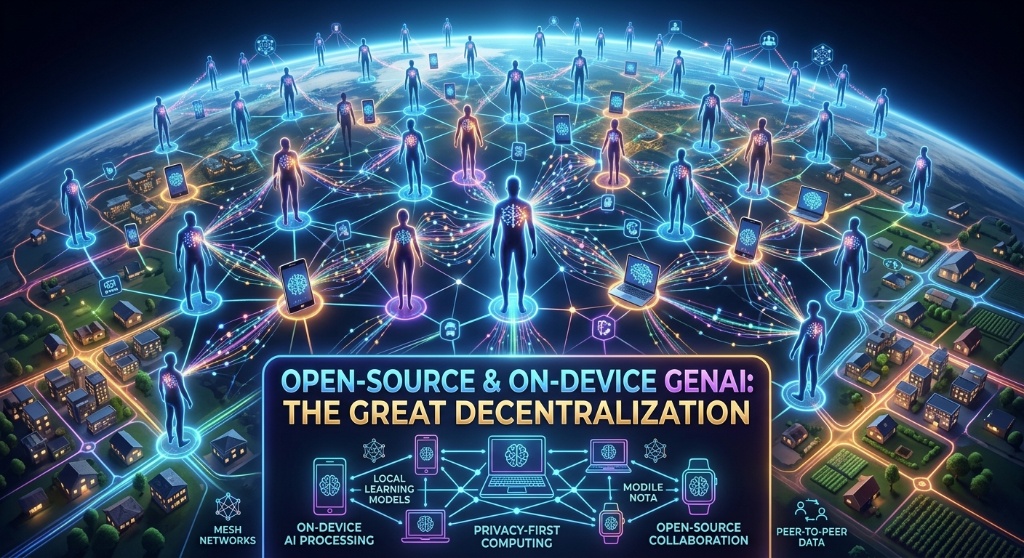
In 2026, the monopoly on intelligence has crumbled. The dominant narrative is no longer about which massive corporation owns the largest model, but how Open-Source Architectures are empowering the individual user through on-device execution.
The 2026 Standard: Edge Sovereignty
Digital sovereignty has returned to the user. Modern NPU (Neural Processing Unit) hardware allows for \"Air-Gapped\" intelligence—enabling you to summarize documents, generate code, or edit media in total isolation with zero internet connection.
2. The Hybrid Inference Model
Operating systems now utilize an Inference Orchestrator. Simple tasks are handled locally to save battery and ensure privacy, while complex, multi-step reasoning is securely offloaded to high-performance cloud nodes using anonymous tokens.
3. Democratizing Innovation
The barrier to entry has vanished. You no longer need a massive GPU cluster to launch an AI startup. Developers are fine-tuning open-source models on consumer-grade hardware and deploying them to millions of edge devices, from smartphones to industrial sensors.
"When intelligence lives on the device, speed improves, privacy strengthens, and trust changes shape."Editorial Pull Quote
The Verdict
AI is no longer a centralized utility provided by a few; it is a Feature woven into hardware and a Public Good refined by the community. In 2026, intelligence is everywhere, and it belongs to everyone.