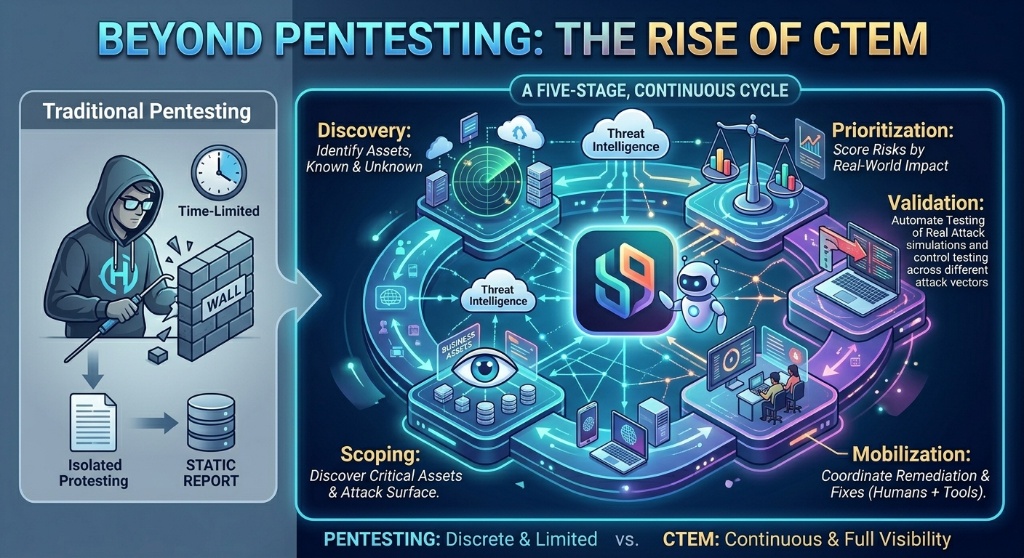
In 2026, the traditional vulnerability management cycle—scan, report, patch—is dead. It has been replaced by CTEM, a systemic approach that treats security as a continuous, business-aligned process rather than a series of IT tasks.
Autonomous Red Teaming
CTEM platforms now use AI agents for 24/7 Breach & Attack Simulation (BAS). This validates whether your controls—like EDR or Zero Trust gateways—actually block the attack path in real-time, rather than just appearing "green" on a dashboard.
Evidence-Based Prioritization
If an AI simulation shows that a specific CVE cannot be reached due to existing network segmentations, CTEM automatically lowers its priority. This allows security teams to focus on the 1% of risks that are truly exploitable and business-critical.
Mobilizing the Fix
CTEM eliminates the "handover gap." Instead of a static PDF report, the system opens a Jira ticket or a GitHub PR containing the exact configuration change needed to close the exposure immediately.
"Security becomes more credible the moment validation stops being occasional."Editorial Pull Quote
The Verdict
Security is no longer a project; it is a continuous, automated process. By 2026, companies adopting CTEM have seen a 50% reduction in successful breaches by moving from a reactive posture to an anticipatory one.