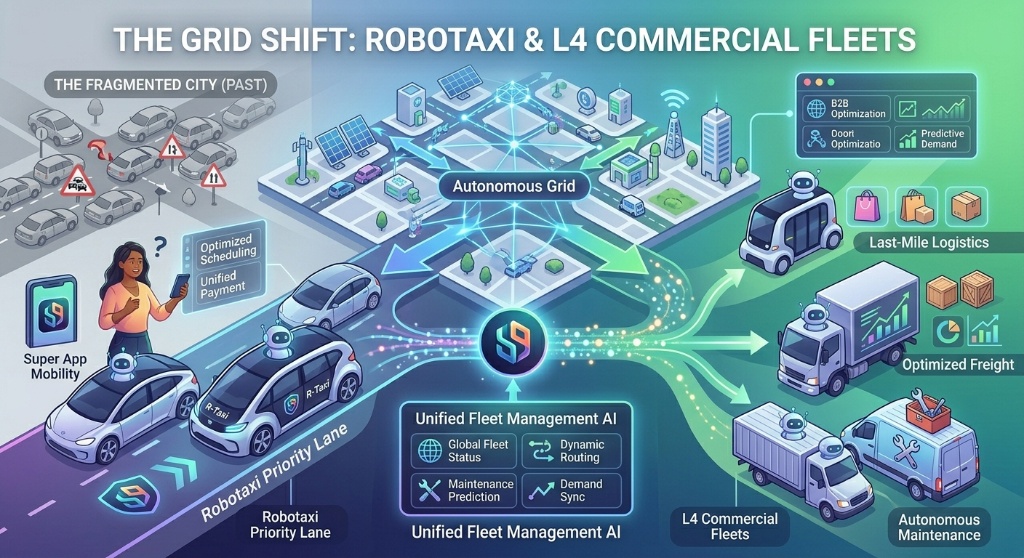
The "Self-Driving Car" is no longer a promise—it is a fleet. In 2026, major urban centers have transitioned their transit backbones to Autonomous Mobility-as-a-Service (AMaaS), fundamentally redrawing the map of the modern city.
Fleet Utilization
Private cars sit idle 95% of the time. 2026 Robotaxi fleets operate at 85% efficiency, cycling through the city to meet demand via predictive AI algorithms.
1. The End of the Parking Garage
Real estate is undergoing a massive shift. As the need for on-site parking vanishes, cities are reclaiming millions of square feet. Parking providers now offer "Commute Tiers," ranging from soundproof Snooze Pods to high-speed Workspace Pods.
2. Middle-Mile Autonomy
While taxis dominate the headlines, the economic backbone of 2026 is Autonomous Middle-Mile Logistics. Heavy-duty L4 trucks move 24/7 between distribution hubs on dedicated "AI Lanes," reducing carbon emissions by 22%.
3. Human-in-the-Loop: Remote Pilots
Autonomous doesn't mean unsupervised. 2026 fleets are backed by Tele-Operation Centers. When a vehicle encounters a complex scenario, a remote human pilot takes over via 6G-link to guide the fleet safely through.
"The transport revolution becomes real the moment the fleet matters more than the vehicle."Editorial Pull Quote
The 2026 Verdict
We are witnessing the "De-Privatization" of the automobile. The Robotaxi has transitioned from a tech demo into a core public utility, as essential as water or electricity.