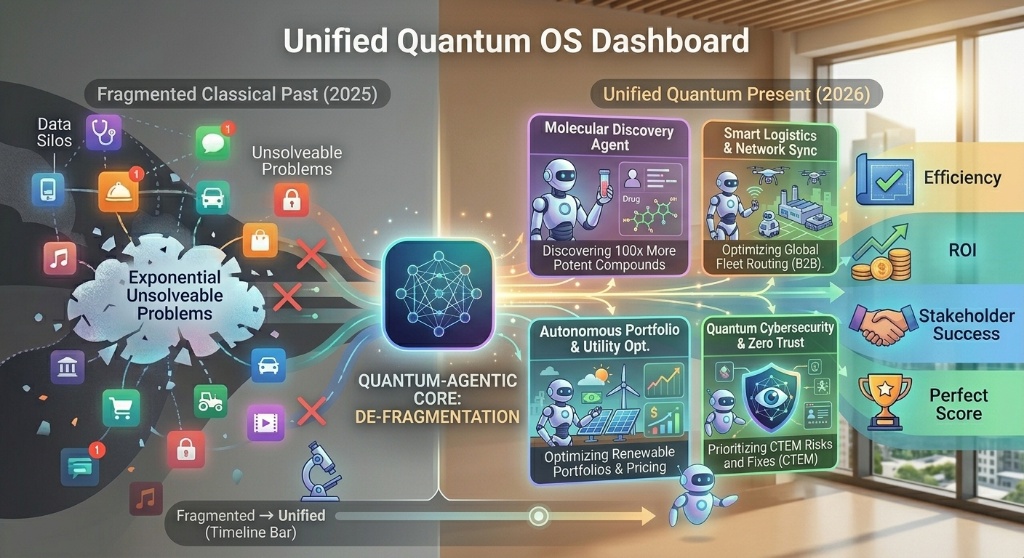
The race for quantum supremacy has ended, and the era of Quantum Utility has begun. In 2026, we are no longer asking if quantum computers work, but how they will reshape global cryptography and material science.
1. Topological Qubits
The greatest hurdle was "Decoherence"—quantum states collapsing due to environmental noise. This year, the introduction of Topological Qubits has allowed systems to maintain stability for hours rather than microseconds.
The 2026 Milestone: Error Correction
We have moved from experimental noisy systems to fault-tolerant quantum clouds, making it possible for commercial enterprises to run complex molecular simulations remotely.
2. Breaking Modern Encryption
The dark side of the quantum revolution is the "Quantum Threat." Standard RSA encryption can be cracked in minutes by a sufficiently powerful quantum computer. This has forced a global migration to Post-Quantum Cryptography (PQC).
3. Molecular Simulation
We are using quantum systems to simulate chemistry at the atomic level. This allows for the discovery of new carbon-capture materials and room-temperature superconductors that were mathematically impossible to model on classical supercomputers.
"When compute changes at the foundation, every layer above it has to rethink what is possible."Editorial Pull Quote
The Verdict
Quantum computing is not a replacement for your laptop; it is a specialized engine for the most complex problems in human history. We have officially moved to the era of "What shall we solve first?"