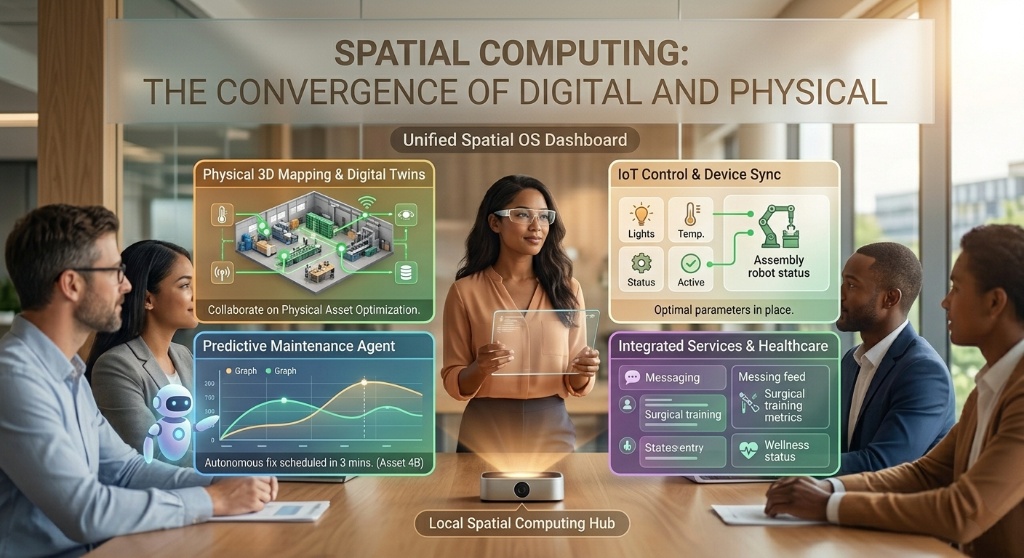
We are witnessing the final death of the "screen." In 2026, computing has moved off our desks and into the physical world around us through Spatial Orchestration.
1. The End of Controllers
Hand-held peripherals are now vintage artifacts. High-fidelity computer vision and neural-link wearables allow for Natural Interaction. Simply looking at a digital object and pinching your fingers is the new universal click.
The 2026 Shift: Occlusion Mastery
Digital objects now obey the laws of physics. If you place a virtual monitor behind your real coffee mug, the mug accurately hides the screen, maintaining the perfect illusion of physical presence.
2. Industrial Holographics
While entertainment was the gateway, industry is the engine. Surgeons use 3D holographic overlays for precision operations, and architects walk through full-scale "Digital Twins" of buildings before the first brick is laid.
"The most important interface shift is not what appears on the screen. It is what stops needing a screen at all."Editorial Pull Quote
The Verdict
Spatial computing is the ultimate interface. It removes the friction between thought and digital action. The digital world is no longer somewhere we "go"—it is simply a layer of our reality.