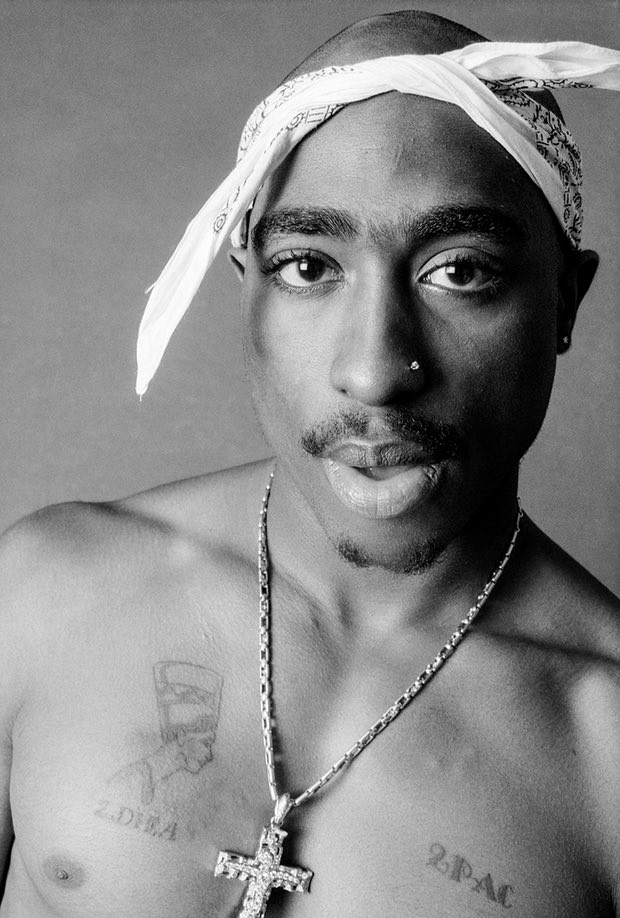
Origins: Born Into Revolution
Tupac Amaru Shakur was born on June 16, 1971, in East Harlem, New York City, into a world already shaped by political struggle and resistance. His mother, Afeni Shakur, was an active member of the Black Panther Party, and many members of his family were deeply involved in revolutionary activism. His name itself carried historical weight, derived from Tupac Amaru II, an 18th-century Peruvian revolutionary who resisted colonial rule.
From birth, Tupac's life was intertwined with ideas of justice, oppression, and resistance. His early environment was not just defined by poverty, but by political consciousness. Conversations about inequality, systemic racism, and survival were not abstract ideas; they were part of daily life. This foundation would later shape his music, giving it a depth that extended far beyond entertainment.
Childhood, Instability, and Artistic Awakening
Tupac's early years were marked by constant movement. His family relocated frequently, eventually settling in Baltimore, Maryland. There, he attended the Baltimore School for the Arts, where he studied acting, poetry, jazz, and ballet. It was in this environment that a different side of Tupac emerged - one that was introspective, creative, and deeply expressive.
He wrote poetry extensively, much of it reflecting loneliness, ambition, and a search for identity. Unlike many artists who later enter hip-hop through street culture alone, Tupac was formally trained in the arts. He understood performance, emotion, and storytelling at a structured level, which later gave his music a unique duality: intellectual and raw, poetic and aggressive.
However, instability followed him. His family eventually moved again, this time to Marin City, California. The contrast between his artistic training and the realities of his new environment created tension within him. He was both a thinker and a survivor - a combination that would define his career.
Entry Into Music and Early Career
Tupac's entry into the music industry began as a dancer and roadie for the group Digital Underground. This opportunity gave him exposure to the industry, but it also revealed his potential as an artist in his own right. In 1991, he released 2Pacalypse Now, a debut that addressed police brutality, systemic inequality, and the struggles of inner-city life.
Tracks like Brenda's Got a Baby showcased his ability to tell deeply human stories, focusing on marginalized individuals often ignored by mainstream narratives. From the beginning, Tupac was not just making music; he was documenting reality.
Rise to Fame and Cultural Impact
Tupac's popularity grew rapidly with subsequent releases such as Strictly 4 My N.I.G.G.A.Z. and Me Against the World. His music resonated because it balanced anger with empathy. He could deliver aggressive, confrontational tracks while also expressing vulnerability, pain, and reflection.
Me Against the World debuted at number one on the Billboard 200 while Tupac was incarcerated, making him the first artist to achieve this milestone while in prison. The album is often regarded as one of his most introspective works, capturing a sense of isolation, paranoia, and existential struggle.
Tupac did not simply narrate the streets - he translated their pain into poetry, making millions feel seen, heard, and understood.Editorial Pull Quote
Legal Troubles and Public Controversy
Tupac's life was also marked by legal challenges and controversy. He faced multiple arrests and was convicted in a sexual abuse case in 1995, which he denied. That same year, he was shot multiple times in the lobby of a New York recording studio, an incident that intensified tensions within the hip-hop community.
These events contributed to his growing sense of distrust and paranoia, themes that became increasingly visible in his music and public persona. His life began to reflect the very chaos he described in his lyrics, blurring the line between art and reality.
Death Row Records and Peak Dominance
After his release from prison, Tupac signed with Death Row Records, a move that marked the most commercially dominant period of his career. Under the label, he released All Eyez on Me in 1996, a double album that became one of the most successful and influential hip-hop projects of all time.
The album featured hits such as California Love and Ambitionz Az a Ridah, showcasing a more confident, aggressive, and larger-than-life version of Tupac. Yet even at the height of his success, underlying tensions remained - both within the industry and in his personal life.
East Coast-West Coast Conflict
Tupac became a central figure in the highly publicized East Coast-West Coast rivalry, a cultural conflict that extended beyond music into real-world tensions. His feud with The Notorious B.I.G. symbolized a broader divide within hip-hop, fueled by media narratives, personal disputes, and industry competition.
While the rivalry brought attention and commercial success, it also contributed to an increasingly volatile atmosphere. Tupac's public statements and diss tracks intensified the situation, making him both a dominant voice and a controversial figure.
The Final Days
On September 7, 1996, Tupac was shot in a drive-by shooting in Las Vegas after attending a boxing match. He sustained multiple gunshot wounds and was taken to the hospital, where he remained in critical condition for several days.
On September 13, 1996, Tupac Amaru Shakur died at the age of 25. His death shocked the world and marked one of the most significant tragedies in music history. Despite extensive investigations, the case remains officially unsolved, contributing to ongoing speculation and debate.
Legacy
Tupac's influence extends far beyond music. He is remembered as a poet, activist, and cultural icon whose work addressed issues of inequality, identity, and survival. His ability to merge artistic expression with social commentary set a standard that continues to shape hip-hop and global culture.
His music remains widely studied, quoted, and celebrated. More than two decades after his death, Tupac continues to inspire new generations, not only through his sound but through his message. He was not just an artist of his time - he became a voice that transcended it.